Showing posts with label Art Instruction Book. Show all posts

Wednesday, 18 May 2016

Book Review: Drawing and Painting Flowers with Coloured Pencils - Trudy Friend


Book Title: Drawing and Painting Flowers with Coloured Pencils
Author: Trudy Friend
Publisher: The Search Press www.searchpress.com
ISBN: 978-1-84448-942-8
Published: 2014, Reprinted 2015
Pages: 144, Colour illustrations
RRP: £15.99

Who For: Intermediate amateur and professional artists wishing to try coloured pencils.


In Drawing and Painting Flowers with Coloured Pencils, Trudy Friend demonstrates the versatility and flexibility of coloured pencils. The book guides the reader from starting out with pencils and materials to tackling complicated compositional pieces.

In the first section, Friend introduces her choice of pencils: the Derwent range. She guides the newcomer through the various types and describes their characteristics and possible methods of application. Coloured pencils are not what they used to be many years ago, these days they are a medium for professional work of the highest quality. This is very evident in Friend's many demonstrations which the book is packed with.

The other sections take the reader through a logical and well organised topics. This makes it possible to dip into the sections rather than reading the book cover to cover. Having said this, for the newcomer to coloured pencils, I would advise a good look through the book so that the various techniques are covered. 

There are two key aspects of the book which I really like. First is Friend's approach to using the full range of pencils, water and non-water soluble, in a multimedia technique. Thus making full use of the potential of the medium and achieving impressive results. Beginning artists may find the approach particularly helpful, especially if watercolour is a medium they are familiar with.

Using coloured pencils in a multi-media approach


The second, is the way Friend uses objects to give the flower paintings and drawings substance and context. For example, she uses objects such as a water pump, a pair of old boots, and even a bicycle! The compositions are effective and the various elements support each other. This is particularly useful for artists who may find painting flowers in a 'botanical' style not easy or not what they want. These compositions can also be found in most gardens


Including objects to give context to paintings


Coloured pencils are the medium of the future. More and more professional artists are finding its versatility, and lucky for us manufacturers of art materials are responding to the demand. New and exciting products are being introduced regularly..

The book will serve the reader well as both an instructional and inspirational resource.

Mo Awkati


Friday, 26 June 2015

Colouring-in Books - A Fad?

Colouring-in books a fad?

What do you think of the recent surge in colouring books for adults. You might have tried them, I haven't. To me coloured pencils are just as good as any other painting medium. But is the use of colouring books a good thing or bad for coloured pencils?

Some coloured pencils users might think this is undermining our wonderful medium and hobby. It might be argued that colouring in someone else's design is not necessarily art in the sense creativity. There is no creativity if it is just a case of filling in the gaps. No thinking , planning, composition, working out lights and darks etc.

Think of it this way: those people who are using coloured pencils with colouring books are in fact spreading the word about coloured pencils, they could become fully fledged artists, they could become people who will appreciate art made with coloured pencils, and may even buy coloured pencil art. So its not a bad thing, coloured pencils as medium will benefit from the publicity. I just wish the media stop calling them crayons!

The only reservation I have is that the colouring books are a fad or craze, how long it will last your guess is as good as mine. What will happen when the fad has gone stale? Will people start to think of coloured pencils as an old fashioned medium? Or worse still as a beginners medium which should not be taken seriously? Or even the public might think coloured pencils are not a serious medium if people use it to colour-in books!

What do you, coloured pencils practitioners, think?

Guest blog post by Mo Awkati

Wednesday, 29 April 2015

Ann Kullberg Workshop

Ann Kullberg has an upcoming workshop in the UK-

Workshop Info: http://annkullberg.com/pages/glasgow

There are currently have 12 of 16 spots open, though we expect it will fill spots very quickly indeed. Get your name down quickly!


Monday, 24 February 2014

UKCPS Member on LAC

UKCPS Member Julie-Ann Maguire has written a piece about her experience working on drafting film for the London Art College Blog. It can be found here. Thank you for that Julie-Ann and I wonder if any other UKCPS members would like to share their experiences of working on this surface.

Thursday, 25 October 2012

Robin Borrett

The following from UKCPS Silver member, Robin Borrett: --

Compendium of Drawing Techniques by Donna Krizek
 
"I'm delighted that this publication features some of my work, but I would like to congratulate UKCPS members Angela Cater, Richard Childs, and Graham Brace, and any other coloured pencil artist featured in this book.
 
Good news for our society!"

Well done to you too, Robin!

Sunday, 12 September 2010

Coloured Pencil Book Review by Pauline Longley

Pauline Longley was the second person to win a copy of Botanical Painting with Coloured Pencils by UKCPS member Ann Swan SBA GM in our blog competition and her book review appears below.

This year Ann Swan was one of the judges of the artwork selected for the 9th Annual Open International Exhibition which opens at the Stamford Arts Centre on Monday 13th September 2010.  The exhibition continues until Friday 1st October.

 
Pauline Longley reading
Botanical Painting with Coloured Pencils
It is Saturday July 3rd and I am sat on my sunny patio doing the Telegraph crossword when the postman hands me the usual junk mail. He carries on to my neighbour only to return with a padded envelope containing a copy of Ann Swan’s Botanical Painting book that I have agreed to review.

I was immediately drawn to the colour of the book and how it co-ordinates with the flowers on the dust jacket. Pinks and purples are an unusual colour scheme for an art book. I couldn’t wait to get reading so whilst my 13 year old grandsons, who had stayed overnight, were engrossed in their computer games I managed to get to page 27 before I heard cries of “Grandma I’m hungry”. “Just a minute Callum.” Callum is always hungry. I then get to page 29 before I here his brother Jack announce “Grandma I’m hungry”. Ah well life is never dull with grandchildren, bless them.

Two hours later, after Mum has arrived and we are all lunched out on salad from the garden and fresh fruit from the local market, daughter and grandchildren despatched home, I get to finish the book and what a lovely book it is too.

For me chapter 1 put into words my own thoughts and findings on coloured pencils which were encouraging. I couldn’t disagree with any of it.

If you are new to art there are great tips on composition, perspective, tone and colour theory in chapters 2, 3 and 4. In chapter 5 Ann has shared some of her coloured pencil techniques that I am sure more experienced artists will find fascinating.

I always seem to struggle with ‘greens’ and chapter 6 has a whole page dedicated to producing realistic greens in nature. As well as covering other colours that can cause issues to the inexperienced coloured pencil artist.

In chapters 7 and 8 Ann explains how she produces the great detail required for botanical art:, fine hairs, highlights, low lights, water droplets, tangled roots and more.

The last chapter showcases a gallery of her work. A fascinating read and a must for those who love to produce detail and realism in their art. I am not a botanical artist and I have no incentive to draw or paint flowers so precisely but this is not just about flowers as Ann shows, these techniques can be applied to vegetables too and I can see no reason why they can’t also be applied to other subjects.

Pauline Longley 2010

Note:  This book review post represents the views of the individual author only.  

Links:

Friday, 10 September 2010

Coloured Pencil Book Review by Lesley Sharman

Lesley Sharman was one of the two winners of a copy of Botanical Painting with Coloured Pencils by UKCPS member Ann Swan SBA GM in the competition which ran on this blog during May.  Pauline Longley was the other winner and her review follows in the next post.

Below you can find Lesley Sharman's book review.

Lesley Sharman doing an exercise from
Ann Swan's Botanical Painting with Coloured Pencils
As I have read many coloured pencil books, covering many different subjects (but none on botanical painting, of which I think this is the first) I have compared this book with them, as well as reviewing the content.

First impressions were very good. It is a hardback book, nicely printed on good paper and very well illustrated, with lots of lovely finished works to admire. It is written in the first person, with a friendly, conversational tone used throughout. The book is about botanical illustration, which has to be anatomically correct, as against flower painting, which allows a looser interpretation. After reading through it I was inspired enough to buy a set of Polychromos to try some of the exercises, but then I was disappointed as I often felt frustrated whilst trying to follow the instructions. I found that they were not detailed enough, unlike most of the other instruction books I have read, and thought that there were possibly some problems with the editing.

The book is divided into nine chapters, each covering a different aspect of botanical art and explaining how the author achieves such outstanding results using coloured pencil.

Ann starts the book by describing how and why she started using coloured pencils and explains a little about the medium, before moving on to materials. She mainly uses Faber-Castell Polychromos, with some Prismacolor Premiers, and gives limited information about other ranges. Then comes the usual basic information on materials as is found in most other CP books, but this is quite succinct.

We are then taken through the procedure of getting to know the subject, including observation, setting up, measuring and colour matching. Some of the information in this section would also be useful for flower arrangers, for example how to keep specimens fresh for as long as possible. Although most botanical subjects are drawn from life there is some information on using photographs.

The next chapter is on composition and style, where the author stresses the need to attract the viewer’s attention as well as for producing detailed drawings, and there is some good information on how to achieve this.

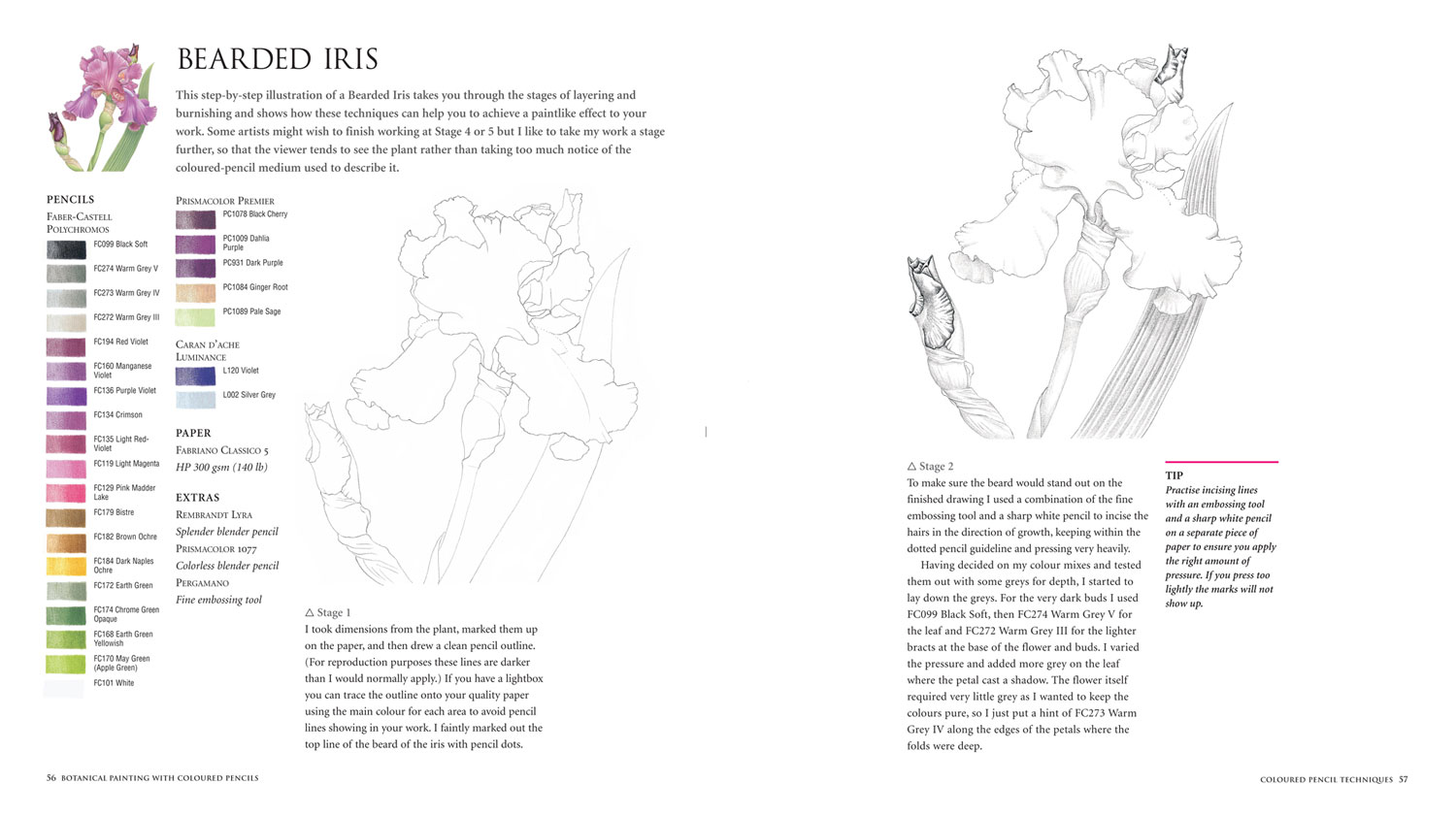
The whole of the chapter “Basic Pencil Techniques” is given over to pencil drawing, with the emphasis on the need to draw well to create realistic botanical illustrations, and looks at basic line and tonal drawings using graphite. There is also some good information on different techniques to use with pencil and Ann covers underpainting graphite, which is quite an unusual technique.  We then move on to coloured pencil techniques in the following chapter, including layering, burnishing and underpainting using felt pens and solvents, with accompanying step-by-step demonstrations of a bearded iris and red peppers.

Chapter 6 concerns colour, where the usual colour theory basics are covered. As botanical artists will need to replicate many shades of green, there is some useful information about the various green pencils produced by the different manufacturers, and recommendations are given. There are also some good tips on how to depict white and yellow flowers convincingly, illustrated by a three-stage step-by-step of an arum lily. However, the finished picture is of two lilies with several leaves, although the instructions only cover one flower, and there is no mention of how the leaves were achieved.

The next chapter, “Small Details”, has some useful information, including an explanation of how to convey hairs and veins on plants in various ways. But I thought the step-by-step of cherries was inadequate. Details were too sketchy: no mention was made of the colours used for the stems, and the “Final Stage” step didn’t even follow on from the previous ones, but showed a different picture completely. I also tried to follow the instructions for depicting bloom on grapes, but found they were very brief and no colours were suggested for the green grapes. The only instructions given were to use grey for the shading, layer the colour and use white for the bloom. (I was getting pretty frustrated at this point and my grapes looked blooming awful!)

Chapter 8, “Finishing Touches” covers how to make finished work look professional. There is some useful information here, such as sharpening edges, polishing the surface and cleaning the paper, as well as framing and presentation.

The final chapter “Gallery” shows some excellent examples of botanical work in coloured pencil by other artists: some lovely pictures to linger over here. There is also a brief checklist and details of stockists and societies (including UKCPS). Throughout the book, the author uses terms which may not be familiar to readers, such as “spadix” , “spathe” and “drupelet” and I thought an appendix or some explanation of these terms would have been helpful.

Would I recommend buying this book?

Yes, if you want to see how Ann achieves such wonderful results using coloured pencil, but not if you want proper detailed instructions to try to achieve similar results yourself. It could be of interest to botanical artists who use the more usual watercolour paints, to gain an understanding of how coloured pencil is used, and to experienced CP artists who can use some of the hints when creating botanical or flower paintings. I felt it would not be good for coloured pencil novices, as the step-by-steps are frustrating to follow due to their lack of detail.

Lesley Sharman 2010

Note:  This book review post represents the views of the individual author only.  

Links:

Thursday, 10 June 2010

Ann Swan book competition winners

Pauline Longley and Lesley Sharman have both won a copy of Botanical Painting with Coloured Pencils by UKCPS member Ann Swan SBA GM in the competition which ran on this blog during May.

If you are a UKCPS member and you've not yet entered, it's not too late to win a copy as there is a separate competition with another two books being awarded to UKCPS members who are mailing their entries to Ann Holden, the Editor of Talking Point.  The details of BOTH competitions were set out in A competition for UKCPS members.

 A two page spread of a step by step demonstration of how to draw an ivy leaf

Once Pauline and Lesley have got their books and read them, they will both be writing a review of the book which will be published on this blog in September - just before the Annual Exhibition.  We'll find out how they rate it and what they found most helpful.

UKCPS would like to extend its thanks to Harper Collins, the publisher of Botanical Painting with Coloured Pencils, for kindly providing four copies of the book for the competition running on UKCPS News and Talking Point

You have until the end of June to mail your entries to the Editor of Talking Point (the address details were provided in the June edition of TP). 

Wednesday, 12 May 2010

A competition for UKCPS members

Four copies of Botanical Painting with Coloured Pencils by UKCPS member Ann Swan SBA GM are the prizes in a new competition for UKCPS members ONLY.  The book was published last month by Harper Collins

The competition will run in two parts and two stages - on the UKCPS News blog (for the those who like their UKCPS news in a digital format) and in the pages of the June edition of the members' newsletter Talking Point for those who don't have a computer.

The start of a step by step demonstration for a coloured pencil portrait of a bearded iris.
copyright Ann Swan / published by Harper Collins


What you need to do to win a copy of Ann Swan's new book

The format for the competition is identical whichever route you choose to use to enter
  • Tell us in no more than 30 words why you'd like to receive - and then review - Botanical Painting with Coloured Pencils
  • The best responses will receive a book - two for digital entries via blog/email and two for paper entries via the newsletter/letter
  • Once you've received the book we would then like the winners to submit a review for publication in either the blog or Talking Point. 
  • The winners can review the book any way you like - how you do it is entirely up to you.  It can be as long or as short as you like; written on your blog or submitted via email or letter.  If you want to go the route of a short video we'd be fascinated to see what you come up with!
The UKCPS News/Talking Point Competition is limited to:
  • UKCPS members only
  • one entry per member.
PLEASE NOTE:  This competition is limited to paid-up UKCPS members only.  We'll be checking the membershp status of the proposed winners with the Membership Secretary before declaring the winners.


Not a member but you would like to enter the competition? - go to our UKCPS membership page now

UKCPS News Blog competition
  • The Blog Competition runs from 12th May to 31st May
  • Submit your entry for the blog competition by email to the UKCPS Blogmaster. If you want to and you've chosen to highlight your entry on your blog you can leave a link in the comments of this blog
  • The two winners will be the members who identify the best reason for receiving this book and/or the best proposal for how they will do a review
  • The names of the two members who each win a book will be announced on this blog in the first week of June
  • Harper Collins will despatch a book to each of the winners in June
  • The winners are then asked to produce a review by mid August (although we can negotiate on dates if holidays get in the way!)
  • The reviews by the two winners will be posted on the blog in September prior to exhibition.
A page spread which focuses on the importance of tonal values and contrast
copyright Ann Swan / published by Harper Collins
    Talking Point newsletter competition
    • The Talking Point competition runs from 1st June to 30th June
    • Mail your entries to the Editor of Talking Point (address details will be provided in the June edition of TP).  
    • The two winners will be the members who identify the best reason for receiving this book and/or the best proposal for how they will do a review
    • The names of the two members who each win a book will be announced on this blog in the first week of July - and in Talking Point in the September edition.
    • Harper Collins will despatch a book to each of the winners in July
    • The winners are then asked to produce a review by the end of September
    • The reviews by the two winners will be published in the December edition of Talking Point.
    All UKCPS members will be able to find out who won all four books when they get the September edition of Talking Point

    If you have any queries please leave your query (or a comment) below.


     The beginning of the chapter on how to tackle botanical art
    copyright Ann Swan / published by Harper Collins

    UKCPS would like to thank Harper Collins both for the books and also for the page spreads which are not available anywhere else on the Internet.  Click the images to see larger versions.

    Tuesday, 11 May 2010

    a slight delay

    Harper Collins are providing images of some page spreads for the blog post about the competition to win a copy of Ann Swan's new book (see Win "Botanical Painting with Coloured Pencils") and it's taking a little longer than expected.

    The post about the competition is now scheduled for tomorrow.

    Monday, 10 May 2010

    Win "Botanical Painting with Coloured Pencils"


    Many UKCPS members were very pleased when UKCPS member Ann Swan's new book - Botanical Painting with Coloured Pencils was published last month. It's the the first practical step-by-step guide to using coloured pencils in botanical painting. Read more about the book at the end of this post.

    Ann Swan SBA GM is a coloured pencil artist and tutor and a member of UKCPS. She is also a signature member of the Society of Botanical Artists and has won a total of four gold medals from the Royal Horticultural Society for her Botanical Art
    An invaluable book for all botanical artists wanting to try this medium
    Society of Botanical Artists (quoted on the front cover)
    Win a copy of Botanical Painting with Coloured Pencils

    Thanks to Harper Collins, UKCPS is pleased to announce a variety of ways in which paid-up members of UKCPS can now WIN a copy of Ann Swan's new book
    • 2 books for readers of UKCPS News to win - Details of the electronic competition to be announced on this blog tomorrow. The closing date is 31st May 2010.
    • 2 books for Talking Point newsletter readers to win - Details of the postal competition will be available in the next issue of Talking Point (June). The closing date is 30th June 2010.
    The UKCPS News/Talking Point Competition is limited to:
    • UKCPS members only
    • one entry per member.
    Not a member but you would like to enter the competition? - go to our UKCPS membership page now

    Coloured pencil artists and fans can also win copies as follows:
    • a signed copy of the book as a Exhibition Prize at the 9th Annual International Exhibition 2010
    • books available as raffle prizes for visitors to the Annual International Exhibition 2010 - details to be announced later as part of the Exhibition publicity.
    Thanks

    UKCPS would like to thank Harper Collins for sponsoring this competition and the exhibition prizes by providing copies of Ann's new book to UKCPS.

    More about "Botanical Painting with Coloured Pencils" by Ann Swan
    This beautifully illustrated book is the first practical step-by-step guide to using coloured pencils in botanical painting and is written by Ann Swan, one of the top exponents of the genre.

    Water-soluble and oil-based coloured pencils are becoming increasingly popular for botanical painting as they are easier to use than traditional watercolour and are more forgiving, yet they produce the same stunning effects. They are especially suitable for the accuracy needed to paint in the botanical style of illustration. In this book Ann Swan gives helpful advice on all aspects of working with coloured pencils, including the techniques you will have to master - underpainting, layering and burnishing. She also demontrates how to mix and build up colour, and how to add those finishing touches that will complete your painting successfully. Several full step-by-step demonstrations are included to show how these techniques are put into practice. The book concludes with a gallery of coloured pencil works by the author, students of botanical painting and other professional botanical painters, providing a wonderful source of reference and inspiration.

    Harper Collins website
    You can read a detailed review of this book by a member of UKCPS on Making A Mark Reviews - see Book review: Botanical Painting with Coloured Pencils

    DON'T FORGET: Tomorrow we'll announce the details of the blog competition

    Thursday, 25 September 2008

    Botanical Illustration by Valerie Oxley

    Valerie Oxley is a member of both UKCPS and the Society of Botanical Artists and specialises in botanical illustration.

    She also teaches across the UK and this week saw the publication of her long awaited book Botanical Illustration. This will be particularly welcomed by Valerie's past and present students who have been urging her to write about the subject for many years!

    Botanical Illustration by Valerie Oxley
    Crowood Press (September 2008)

    Valerie's botanical art credentials are impressive. Valerie developed the Diploma in Botanical illustration at the University of Sheffield, Department of Lifelong Learning (TILL). She's also the Vice-Chairman of the Northern Society for Botanical Art and the Chairman of the Florilegium Society at Sheffield Botanical Gardens.

    Her new book has been written for students of botanical art - for those new to this aspect of art as well as for those with some experience wishing to develop their expertise. It deals with the practicalities of botanical art and the related botany of the subject and covers the following topics:
    • the history of botanical illustration,
    • the botany of plants and flowers,
    • materials and equipment,
    • preparation of plant material,
    • observation techniques,
    • starting to draw,
    • developing tonal studies,
    • preparing to paint,
    • colour theory,
    • painting techniques,
    • what to paint and how to paint,
    • alternative media including coloured pencil techniques,
    • correcting mistakes and
    • finishing touches
    • photography and computers.
    If you're interested I'd recommend you take a peek inside the book by using the Search Inside facility on the Amazon website.

    It is also very well illustrated with over two hundred colour illustrations by over fifty artists, including a full page illustration of Carlina involucrata by UKCPS member Eleni Mcloughlin and coloured pencil drawings by Susan Christopher Coulson, Vivienne Brown, Jane Cowan, Helena Anderson and, of course, Valerie herself!

    Coloured pencil matters and techniques which are covered include dry and water resistant coloured pencil techniques, pen with coloured pencil (and Eleni's illustration), Papers, Drafting Film, Erasers, Pencil Sharpeners, Blenders, Indenters, Embossers and colours that resist, removing coloured pigment, use of the grisaille approach and dealing with wax bloom. There is an eight point suggested "working method" and finally a bit about fixative and storage and a mention of water soluble pencils.

    You can also find out more details about Valerie's workshops on the Workshops page of the UKCPS website. This also provides details of courses run by all other UKCPS members who teach - or at least the ones UKCPS has been told about! ;)

    Book Details: Botanical Illustration, The Crowood Press, (September 2008) ISBN 978-1-84797-051-0

    Sunday, 13 April 2008

    Books and a Course


    A couple of books in the "Bible" series by Search Press are being released and may be of interest to our members. The first of these to come out is the "Landscape Artists Drawing Bible", by Hazel Harrison, which features work by our members Graham Brace, Peter Woof and Robin Borrett, and in May the "Coloured Pencil Artists Drawing Bible" by Jane Strother, will be released. Robin also has work in this, but I have yet to hear of other members who do - I am sure there will be some, as the publishers used the UKCPS site to contact several of our members. The value of our Members Gallery pages asserts itself again - a gentle reminder to those who have not yet availed yourselves of this opportunity!

    The other thing I wanted to mention in this blog is that Jonathan Newey has some spaces left in a 'Drawing landscapes with coloured pencil' course at the Preston Montford Field Centre near Shrewsbury on the weekend of 16-18 May. Please contact Preston Montford Field Centre, Montford Bridge, Shrewsbury, SY4 1DX Tel:01743 852040 if you are interested.

    Friday, 4 April 2008

    Bits and Bobs from Bob

    Richard Childs, "Hope of Sepilok"

    Several short pieces in this blog. Let us start with several big congratulatory cheers, with possibly more to come! First, for members Richard Childs and Jonathan Newey, who have both been accepted into the Mall Galleries Exhibition for the Wildlife Artist of the Year, run by the David Sheppard Wildlife Foundation, between 24th and 28th June this year. The final winner will be announced on the Preview Evening - we are keeping our fingers crossed for both members. Richard's piece is "Hope of Sepilok", which was a prizewinner in the 2008 UKCPS Exhibition, and which has been instrumental in raising a good sum for the Orang-utans in Borneo.

    Graham Brace, "Dancing Trees"

    Next, congratulations to member Graham Brace, who has a five page article in this month's (May) Artist and Illustrator magazine, with several examples of his beautiful work. Also in this magazine is a reference to the UKCPS Colour Comparison Charts, so we hope for more orders of those.


    Next, a request from one of our members, Karen Coulson, to publicise her local art shop, which, despite the name, is in Lymington, Hants! Happy to do so, on recommendation of our members. This very friendly store may soon be stocking the new Luminance pencils from Caran d'Ache that are causing a stir at the moment, but it already has a good stock of Derwent and Caran d'Ache as well as some harder to find papers like the Art Spectrum Colorfix. Clicking on the picture above will take you to their site. See what Peter Weatherill, Nicole Caulfield and others think of Luminance here. While on the subject of members recommendations, if we have any members in North Queensland, Australia - and yes, we do have some in the Antipodes! - they might be interested in contacting Frieda van Aller to talk about visiting artists in the Port Douglas region.


    Finally, if you have not already done so, get this book. Arlene Steinberg, known to many of us through "Scribbletalk", has written what I feel sure will become a standard in the coloured pencil world. I received my copy yesterday, and devoured it in one sitting, and am now going through it again to savour it. The best way I can sum it up is to say that Arlene does not just teach you how to become a coloured pencil artist - she shows you how to be an artist. And remember if you buy this book through the Society Book page, we benefit by a few pennies - which we can do with!

    LinkWithin

    Related Posts with Thumbnails